| Status: | Active, full but can join waiting list |
| Leader: | |
| When: | On Wednesday mornings 10.30 every 4 weeks |
| Venue: | Hasbury Methodist Church |
What do we do?
We meet once every 4 weeks during term time to exercise our minds and fingers by folding paper. We learn something new while producing a variety of models and having fun.
New members follow a structured course over about 4 terms to learn the basic folds and techniques of Origami to enable them to then tackle models of their own choosing.
We often start a meeting with everyone making a simple model demonstrated by the leader or other member of the group. Members who have completed the course then work on their own projects while new members learn further techniques.
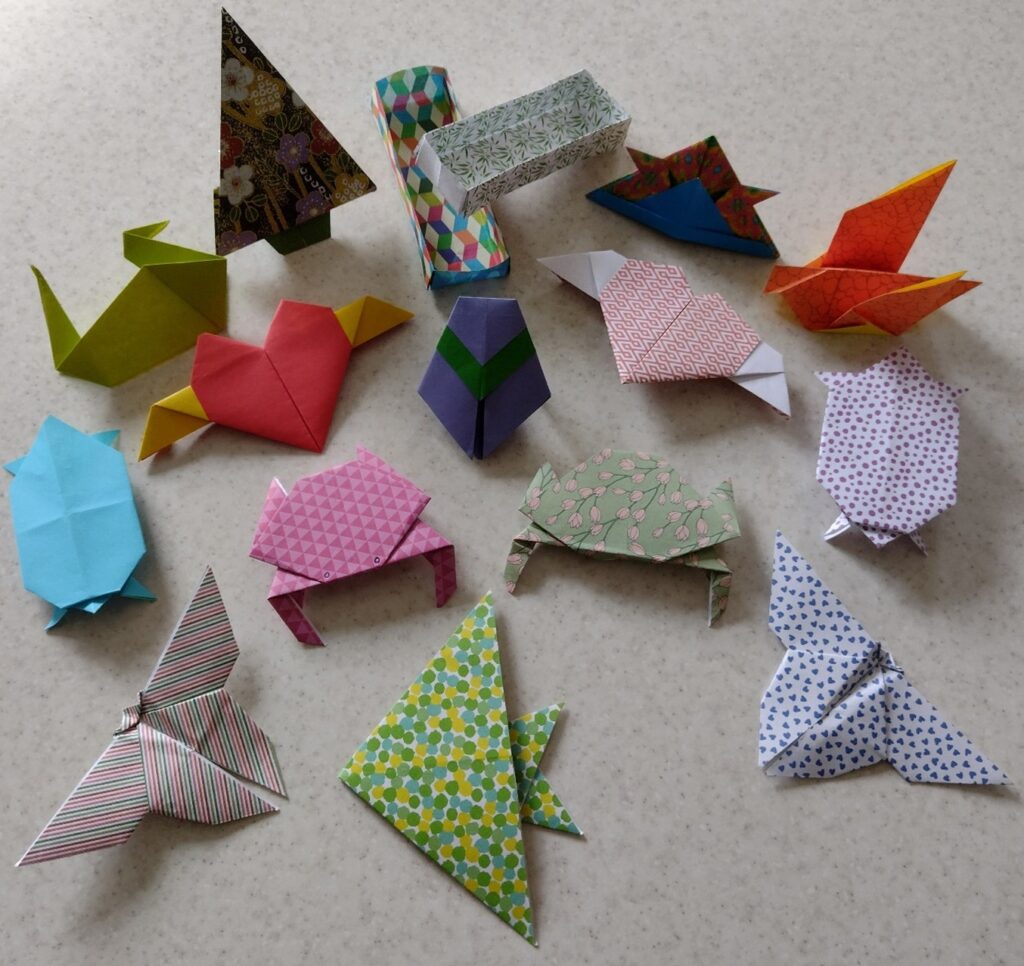
The image shows some models made by a new member in her first few months.
Thinking of joining us?
Members with no experience may only join the group at the start of a course. However, those already familiar with the basics of Origami may be able to join at other times. In either case, contact the Group Leader to enquire.
What will I need?
Beginners are provided with everything they need for the first two meetings. After that, they will need to purchase a book for the course and suitable Origami paper; full information on these is given in the first session,
Group activities
At Christmas and Easter the whole group usually make some models (demonstrated or working from diagrams) appropriate to the season.

Ways we learn origami
- Watching and following a personal demonstration
This is an excellent way for a beginner to learn as you can pick up tips on how to fold and ask questions as well as checking your folds against those of the demonstrator. The disadvantage is that you quickly forget the sequence of folds afterwards so it is difficult to reproduce them on your own. - Understanding and following diagrams
The interpretation of Origami diagrams is an essential skill. The symbols used are international which means you can follow instructions with no words or those in another language. The great advantage is you can always refer back to the instructions or just to a few steps that you are unsure of. Acquiring proficiency takes practice but is helped by the detailed book we use to learn techniques. The only disadvantage is that 3D models are difficult to represent in diagrams and thus challenging for beginners to follow without help. - YouTube videos
This can be like having your own personal demonstrator available whenever needed and you can speed up or slow down the video to suit you. However, the quality of the instructions can vary considerably and it can be very annoying having to keep pausing and replaying sections. We do not use YouTube regularly in our meetings but do recommend carefully chosen videos for certain folds and models, especially 3D ones. The combination of a diagram with a video to help with the tricky parts is excellent. - Practice
Don't expect to get a model perfect the first time you make it; you need to develop your own ways of making neat, accurate folds and this takes practice. Even then, it usually takes at least 3 attempts to fold a model you are satisfied with, so don't start with your best paper! Equally, don't be disheartened if the paper ends up in the recycling bin - it's only a piece of paper, so be kind to yourself.
Because beginners follow a structured programme where folds learnt in one session are repeated and built on later, you should try to do some homework. Sometimes suitable similar models may be recommended to try on your own. If you have to miss a session, then you will be sent details of what you need to catch up on before the next one. Towards the end of the course, you may be asked to prepare something ready for the next session to save time on more complicated models. - Learning from other members of the group
Members who have acquired the basics develop their skills by working with other members of the group. They usually start by attempting or repeating models from the book to gain confidence. The whole point of u3a groups is to learn from each other, and helping someone else is an excellent way to improve your own understanding.
Why members join the Origami group
Members of the group enjoy Origami for many different reasons, a few being:
- Learn a new skill
- Keep mind active
- Keep fingers supple
- Rediscover a childhood interest
- Socialise over a common interest
- Mindfulness - it can be very calming to concentrate on a piece of paper
- Enjoy using nice paper
- Enjoy the precision of folding
- Enjoy artistic interpretation using paper
- Enjoy aspect of Japanese culture
- Satisfaction of success, especially after struggling on a model
- Maths behind Origami - not at all essential, though enriching if you are so inclined
- Activity with grandchildren
- Most important - FUN
Useful links
- British Origami Society
Videos, diagrams and information with much of it available to non-members.